

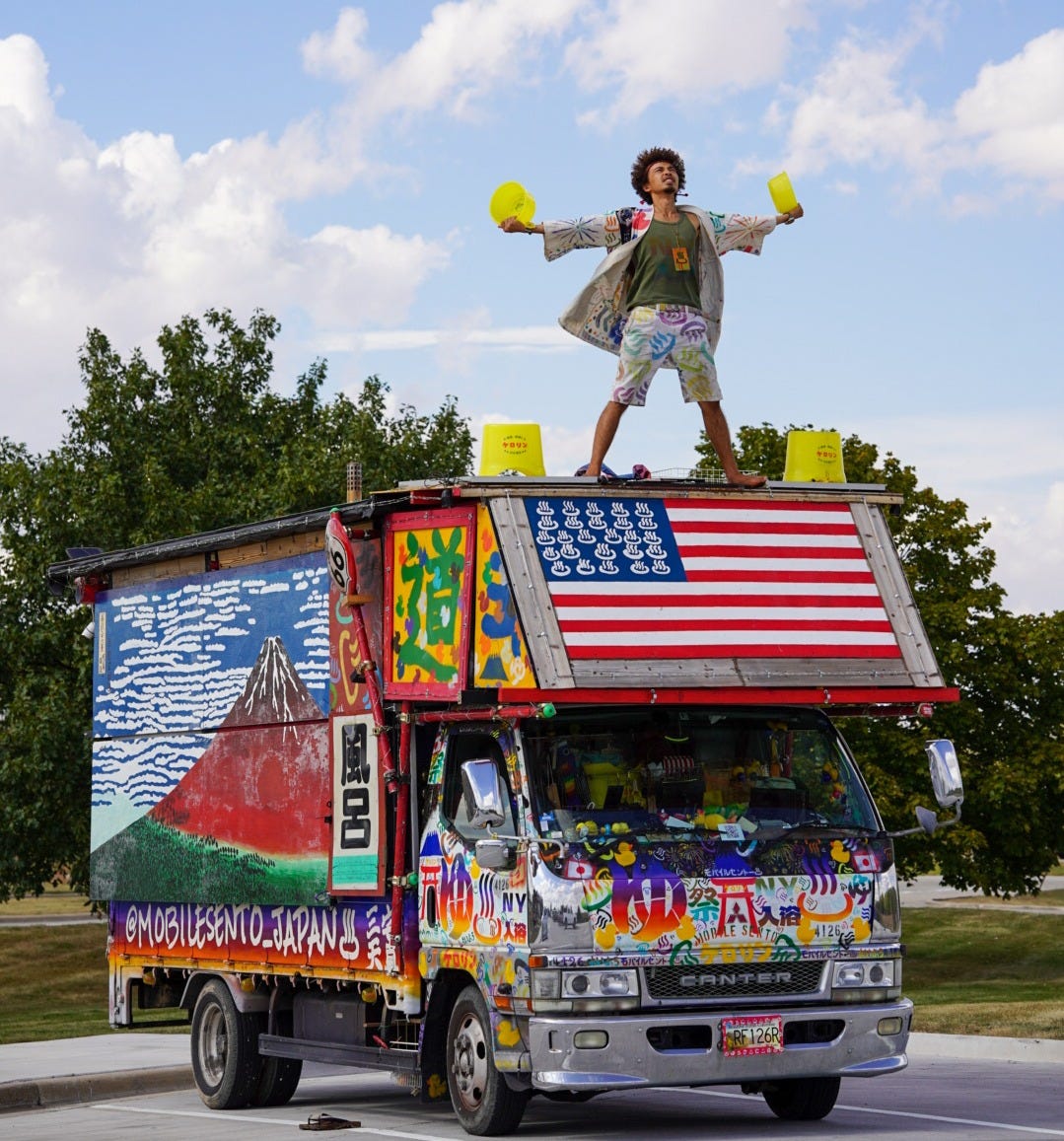
For Taka Miyake, the visionary behind Mobile Sentō, communal bathing is a mobile art. He built a sentō inside a Japanese truck, complete with a hand-painted Fujiyama mural and drove across America sharing bathing rituals with strangers. Even Eric André dropped in for a soak - check out his interview here. We catch up with Taka en route to Burning Man (Aug 30 – Sep 7) to talk bathing dreams and the best bucket. Plus sweat and steam on Burning Man’s playa, and scroll down for news.
Taka’s Mobile Sentō goes to Burning Man
CULTURE OF BATHING: Last year you travelled across America to New York in a self-built mobile sentō, and now you’re crossing America again on your way to Burning Man. Can you tell me more about the project?
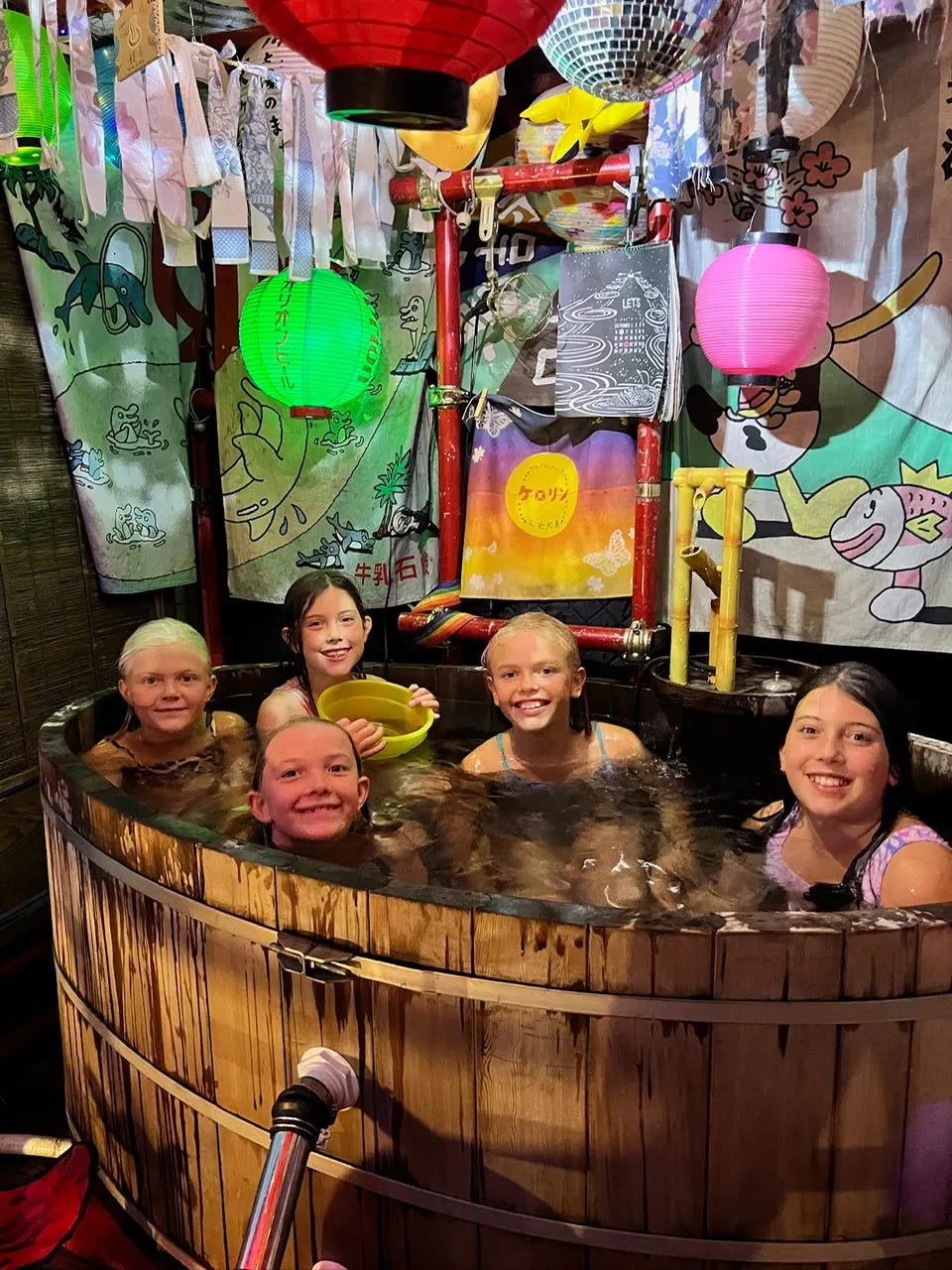
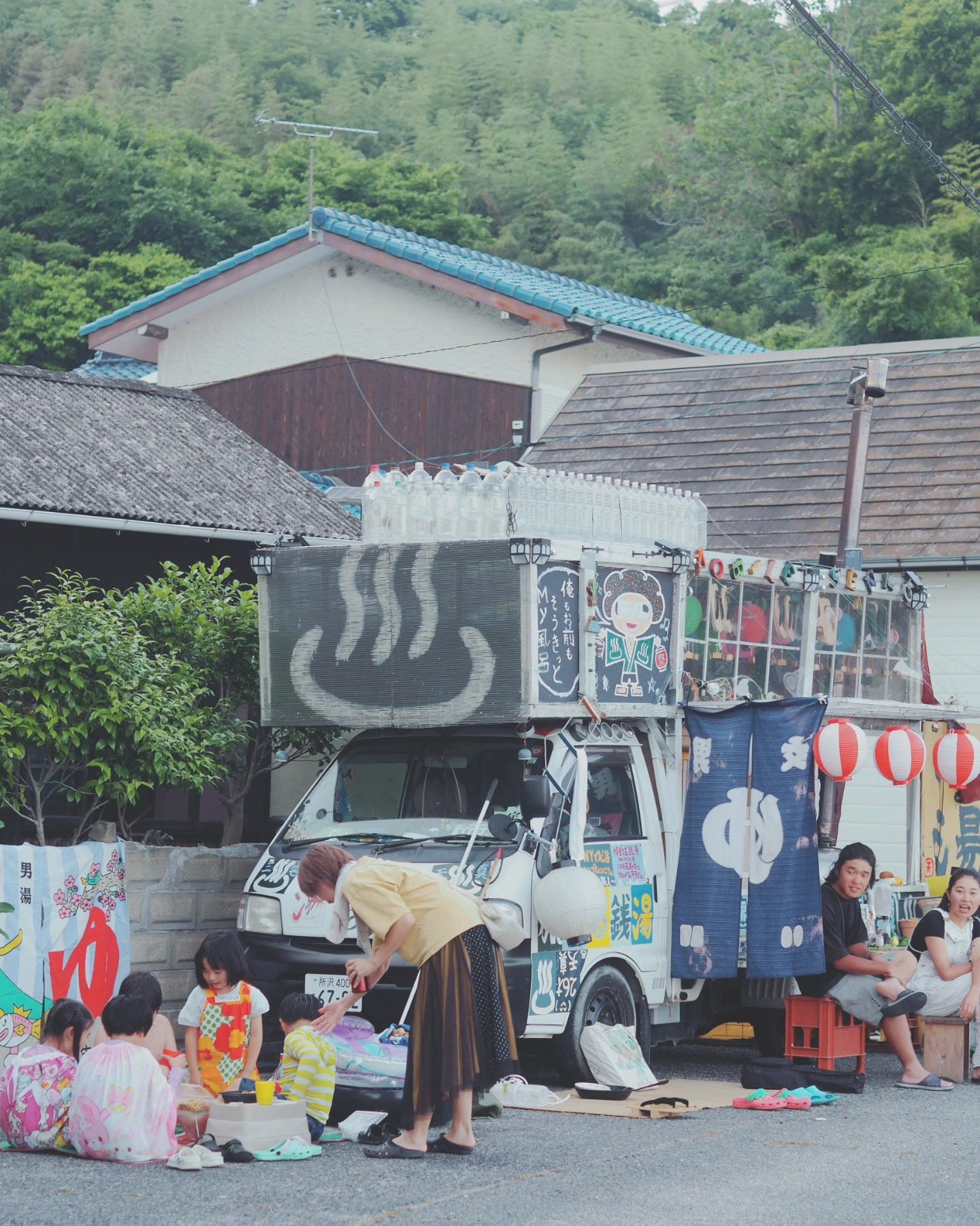
TAKA: Three years ago, I bought a truck in Japan, shipped it to Victoria on Vancouver Island and built a mobile sentō from scratch in Canada. It took two years because shipping, vehicle registration and everything was expensive. I worked as a landscaper in Canada to save money and practise English. I worked on the truck every weekend. Last year I finally finished the sentō truck and came to the United States on June 1, 2025. Then I started a big journey from Seattle to San Francisco and Los Angeles, through Route 66, to Chicago and finally New York in November. I met a lot of nice people on the way.
COB: How did the idea to build a mobile sentō come about and what was your inspiration?
TAKA: When I was a college student, I backpacked to almost 50 countries around the world to see new cultures and meet new people. After graduating, I decided I wanted to combine Japanese sentō culture with travelling. I thought it would be cool to mix old and new cultures, so I just gave it a shot. Actually, this is my second sentō truck. I had a smaller one in Japan, so this project is eight years in the making.
COB: What was your first bathing experience, and did you bathe with your family?
TAKA: I don’t remember but I think it was an onsen or sentō – my Dad used to take me as a child. When my grandmother passed away six years ago, her friends told me that she went to the sentō every day at the same time, in the same seat and talked to everybody. So my grandmother’s love for sentō has inspired me too.
COB: What did you study? Would you describe yourself as an artist?
TAKA: I majored in business management, so no architecture, design, painting or carpentry. Everything was self-taught.
COB: That must have been a big learning curve! Are there any stories behind the paintings that you’ve done and the artwork on the sentō truck?
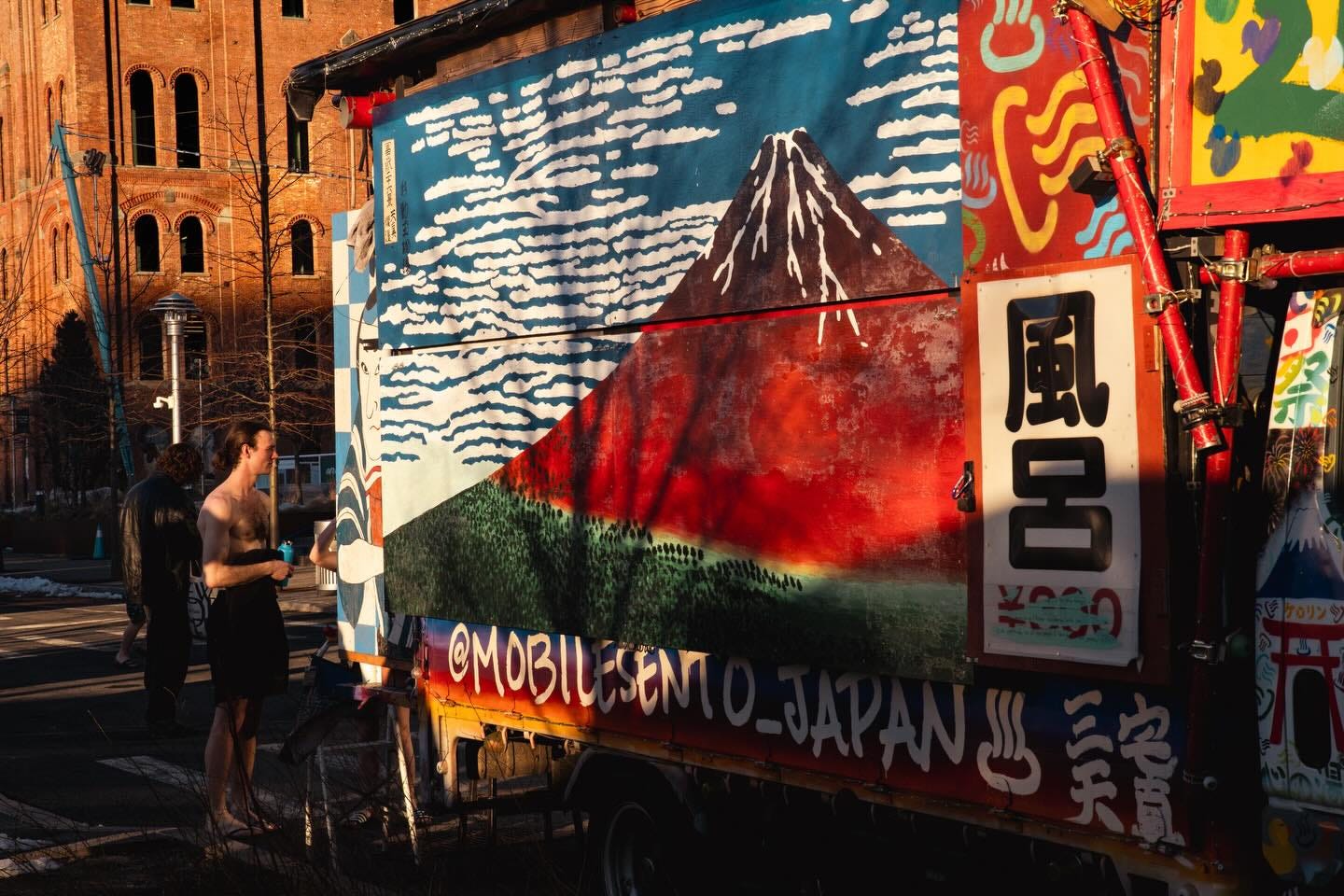
TAKA: There’s a huge Mount Fuji on the side of the truck which is inspired by traditional wall murals inside sentō. It took me five days! On the back of the truck, I did a traditional Ukiyo-e-style painting. At the entrance, I also have a Torii gate (which usually marks the approach to a Shinto shrine). It’s kind of a secret gate because it’s not made of wood. When I travelled across Japan with my first mobile sentō I found this small rural shrine which had a gate made from PVC pipes. Some smart elders probably decided to do this because it’s cheap so I recreated that in the truck.
COB: I noticed you have the typical yellow buckets – did you bring them from Japan?
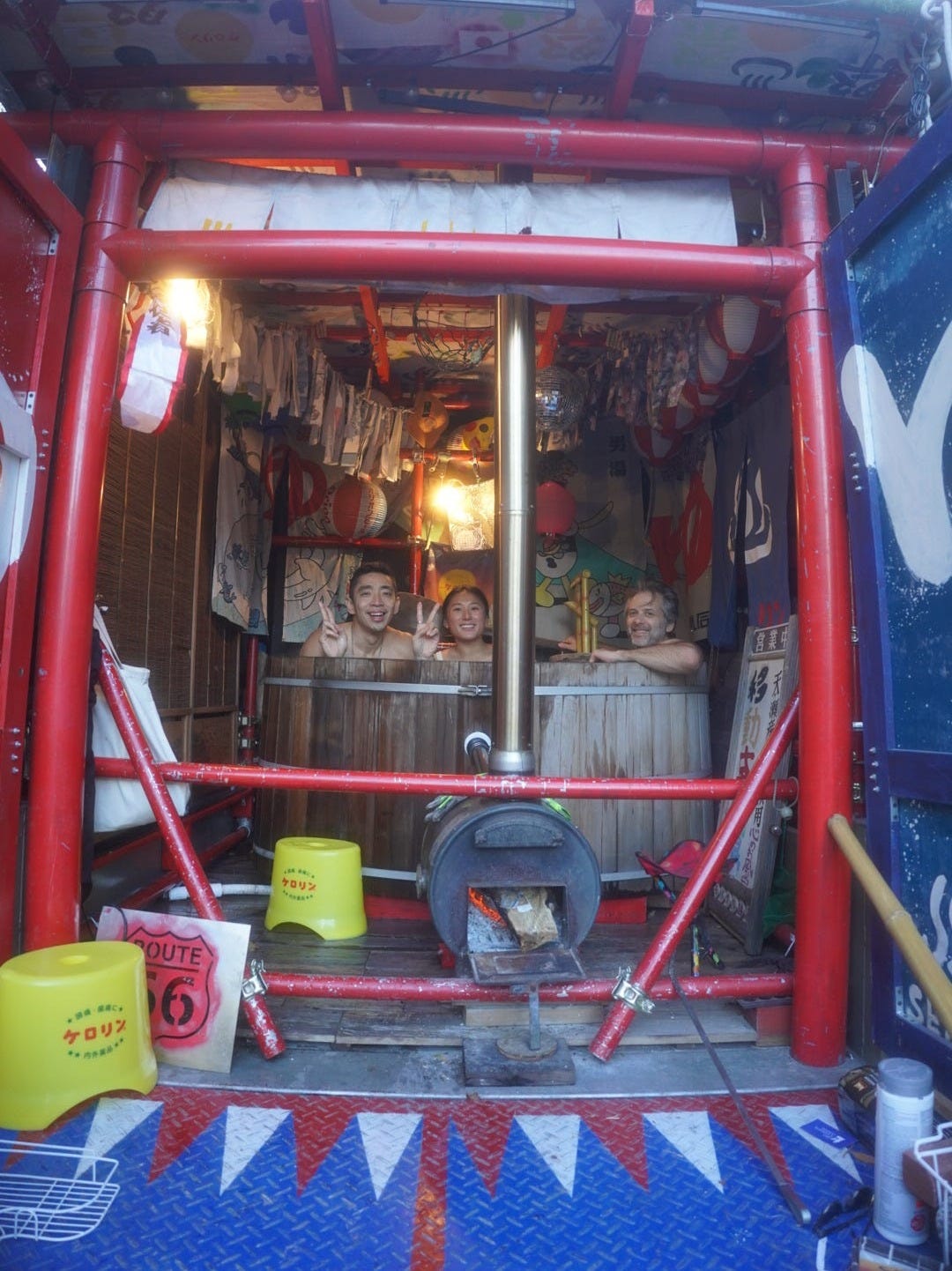
TAKA: The yellow Kerorin bucket? That’s also my favourite! You can find them everywhere in sentō and onsen in Japan. They’re made by a pharmaceutical company which used to advertise on the buckets. I sent them a letter to explain the project and was surprised when they gave me a lot of things.
And I can tell you the story of the tub. I couldn’t ship one from Japan, so I had to find one in Canada. I found a company, Forest Cooperage, which makes tubs from cedar and visited their factory. When I saw their craftsmanship, I was worried about how I could afford it, but eventually they sold me a second-hand tub for only $100 bucks, as a sponsorship – so they are my friends too.
COB: How have people reacted to Mobile Sentō?
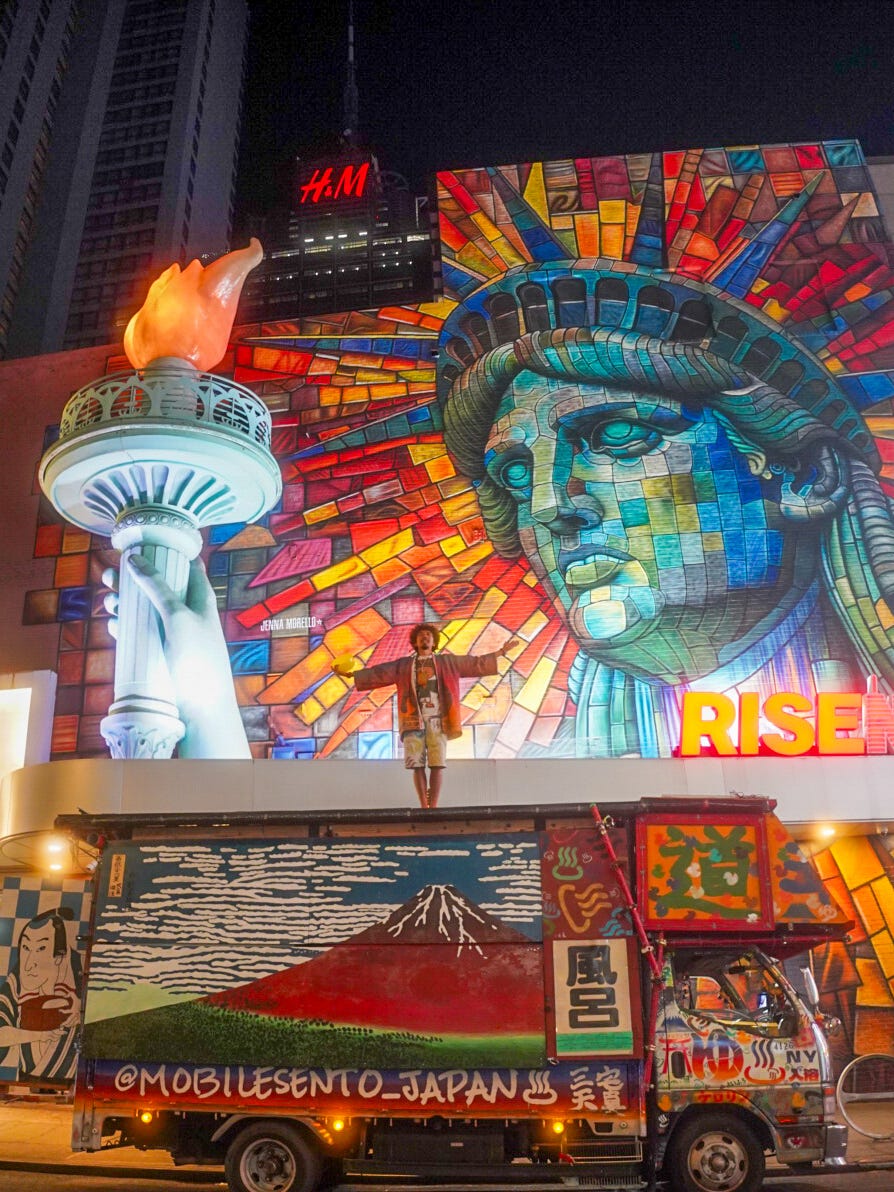
TAKA: If I do the sentō, usually they are very surprised: “what a super-crazy truck!” In Mendocino, California, last July, after I parked my vehicle at a grocery store, I found a note inviting me to stay with someone. Of course, I said yes, and stayed with their family for a few days. Later I made a lot of bathing connections and people put me in touch with others on the way. But I can’t do a sentō everyday as it takes 5-6 hours to set up, so I just keep driving. Actually, I hate driving. I often don’t talk to anyone all day.
COB: What have you learned by doing Mobile Sentō?
We have an old Japanese saying that we are all the same when we are naked, just human beings. In the United States, everybody is so different; background, religion, culture, eyes, hair, skin, language, even their English language is very different! But we have so much in common once we sit inside a sauna or sentō and we can share that special moment.
“In an age of evolving AI, I ask myself what does it truly mean to be human? We need connection and shared experience – so I think people need bathing culture.”
Taka Miyake
COB: What are your plans and expectations for Burning Man? Why do you want to go there?
TAKA: Visiting Burning Man is one of my dreams but I didn’t make it last year. During my last sentō session in Brooklyn, I met Daniel and his fiancé Lei-ling who are Burners and founders of Metaphormosa. They bought my truck, which was a miracle as I couldn’t take it back to Japan. They are getting married at Burning Man this year, so they invited me to drive the truck and of course I said yes! I have no idea what to expect or how I’m going to do a sentō at Burning Man because people have told me that water is hard to find. So perhaps the sentō is a sculpture, or we could use the sauna in the back. But they told me not to worry about it and just keep driving to Black Rock City.
COB: And what’s next after Burning Man?
TAKA: I will go back to Japan to save money. At the beginning of next year, I’m planning to build a new mobile sentō in Europe. I have no friends, no connections, but, yeah, maybe I will just give it a shot. I can make it.
COB: I’m sure you will.
TAKA: I’m going to buy the truck in Europe this time, and start painting it. And then start exploring next Spring. I want to visit a lot of places like UK, Finland, Norway, Germany.
COB: What were the most difficult moments during the sentō project?
TAKA: Everything was difficult! Now, I think it’s funny but at the time I had no idea what to do, for example, shipping the truck to Canada. But people have helped me – thanks to everyone. As a teenager I was bad at communicating, I was shy and not good at making friends, so I always felt lonely. And now I have made friends around the world – maybe that’s why I continue the mobile sentō project.
COB: What’s your perspective on how bathing culture is developing? Are more people into bathing?
TAKA: Yeah, definitely! Especially now, in an age of evolving AI, I ask myself what does it truly mean to be human? We need connection and coming together, we need shared experience so I think people need bathing culture more, in Japan, in the U.S.
Interview by Ria Hawthorn for Culture of Bathe-ing @ria.hawthorn
Find out more about Taka’s journey here: @mobilesento_japan
Steam on the Playa: Bathing at Burning Man
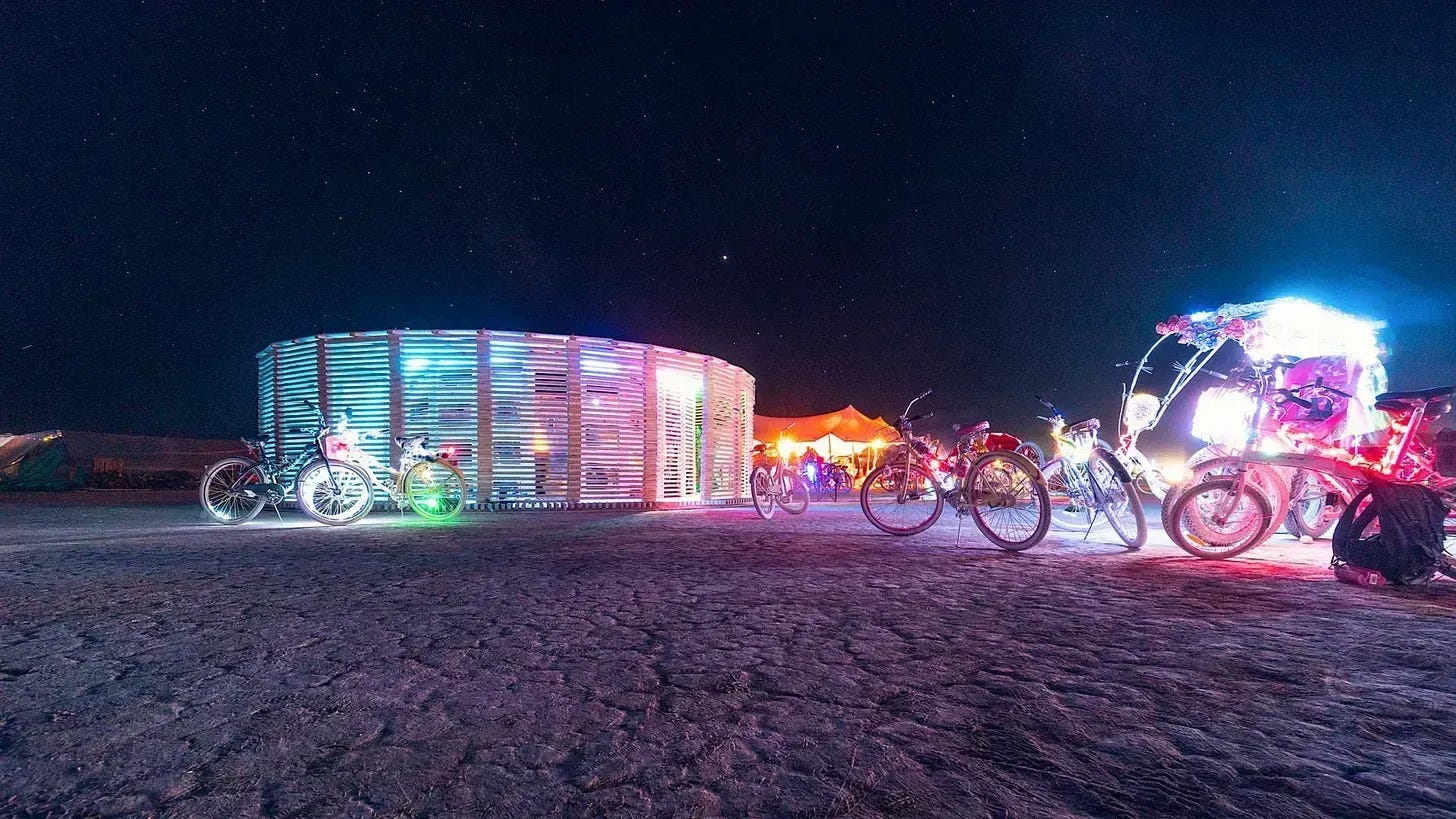
This year, Taka joins a tradition of maverick sweat bathing at Burning Man festival in the Black Rock Desert, Nevada, where “avant-garde revelers come to bend their minds, shed their clothes and incinerate a large wooden effigy” says the New York Times. Cash is out, as individual camps bring offerings of entertainment, drinks, wellness, legendary art cars, installations and, of course, sweat bathing. Desert and water make unlikely companions and, in a temporary city built on radical self-reliance, hauling in the materials and fuel needed for bathing is an exercise in efficiency. But here it’s not only about cleansing, it’s also about creating transformative bathing experiences.
Each sweat-bath offering is described as an “individual work of art” by Mikkel Aaland who visited while filming the final episode for his documentary Perfect Sweat. There he met long-time burner John Payne who brought the first sweat-bathing experience, the Steam Bath Project, to the playa from the early 2000s onwards. Payne uses a hot tub water heater to create steam and finishes with a spray rinse, cutting water use from 30 gallons to just a quarter gallon in a ritual of relaxation that “washes away emotions”. Since then, bathers have steadily caught on to the pleasure of steam on the playa.
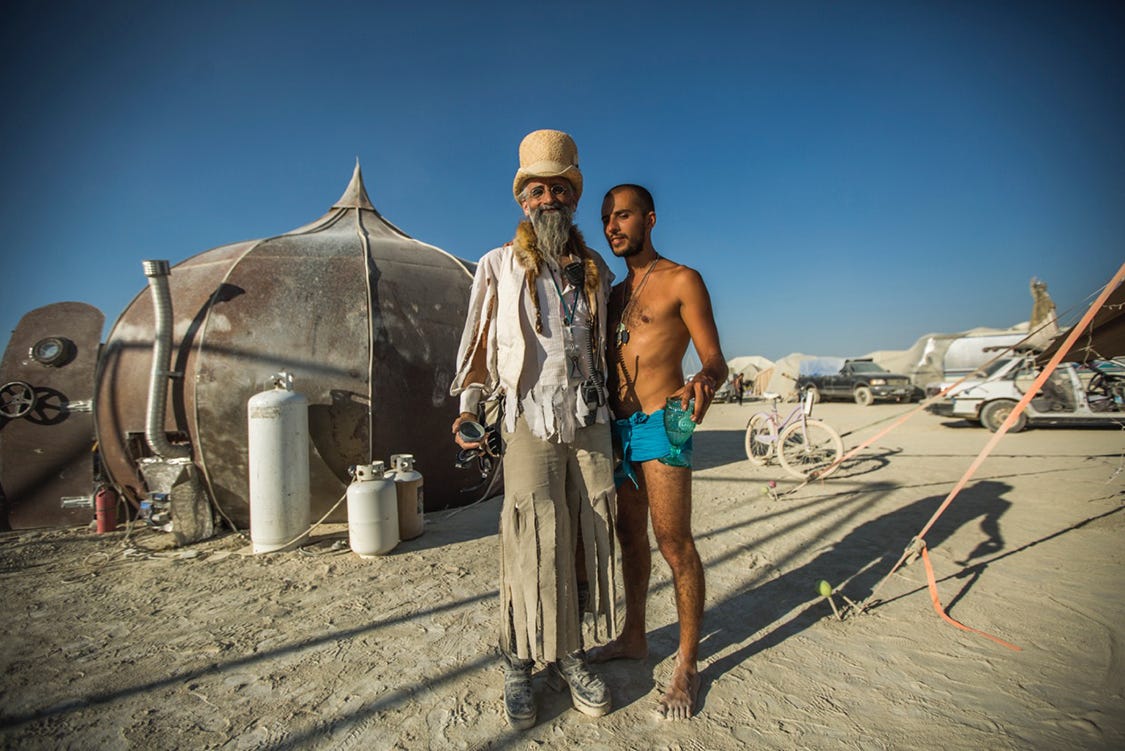
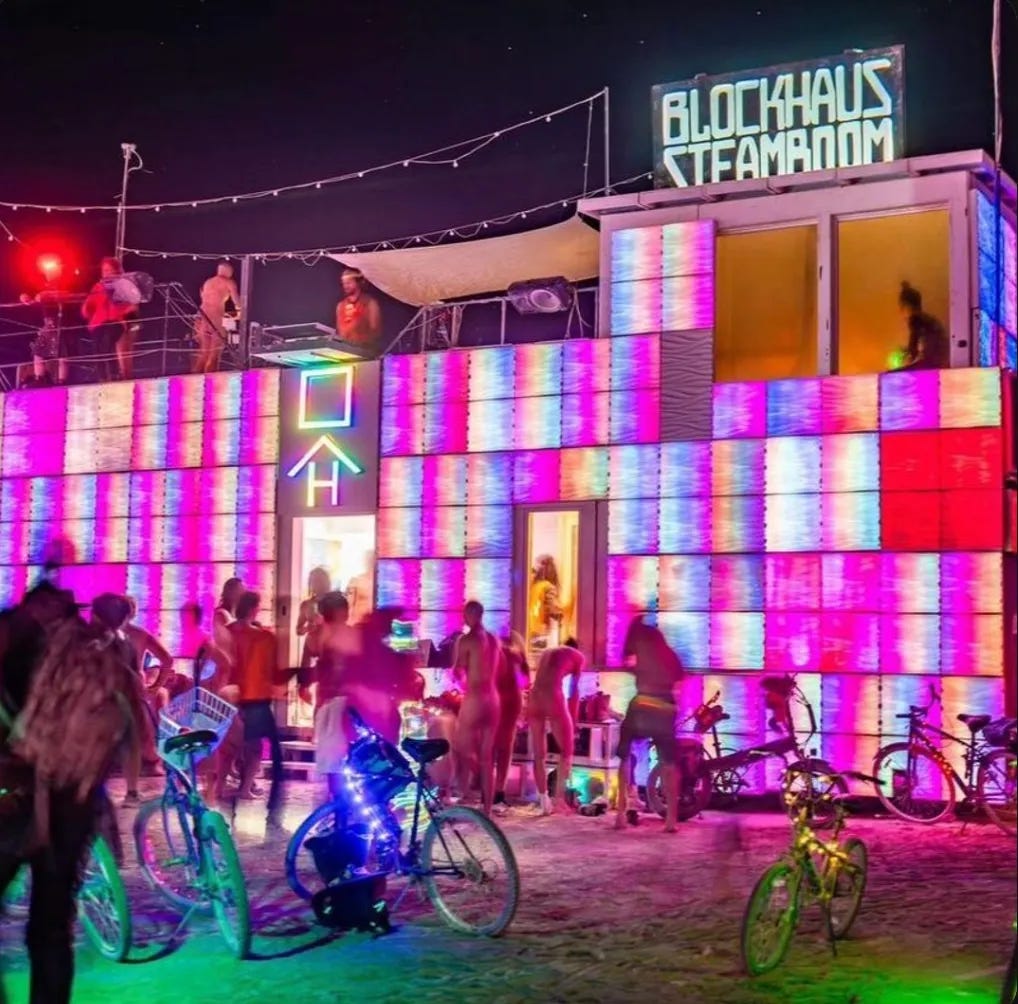
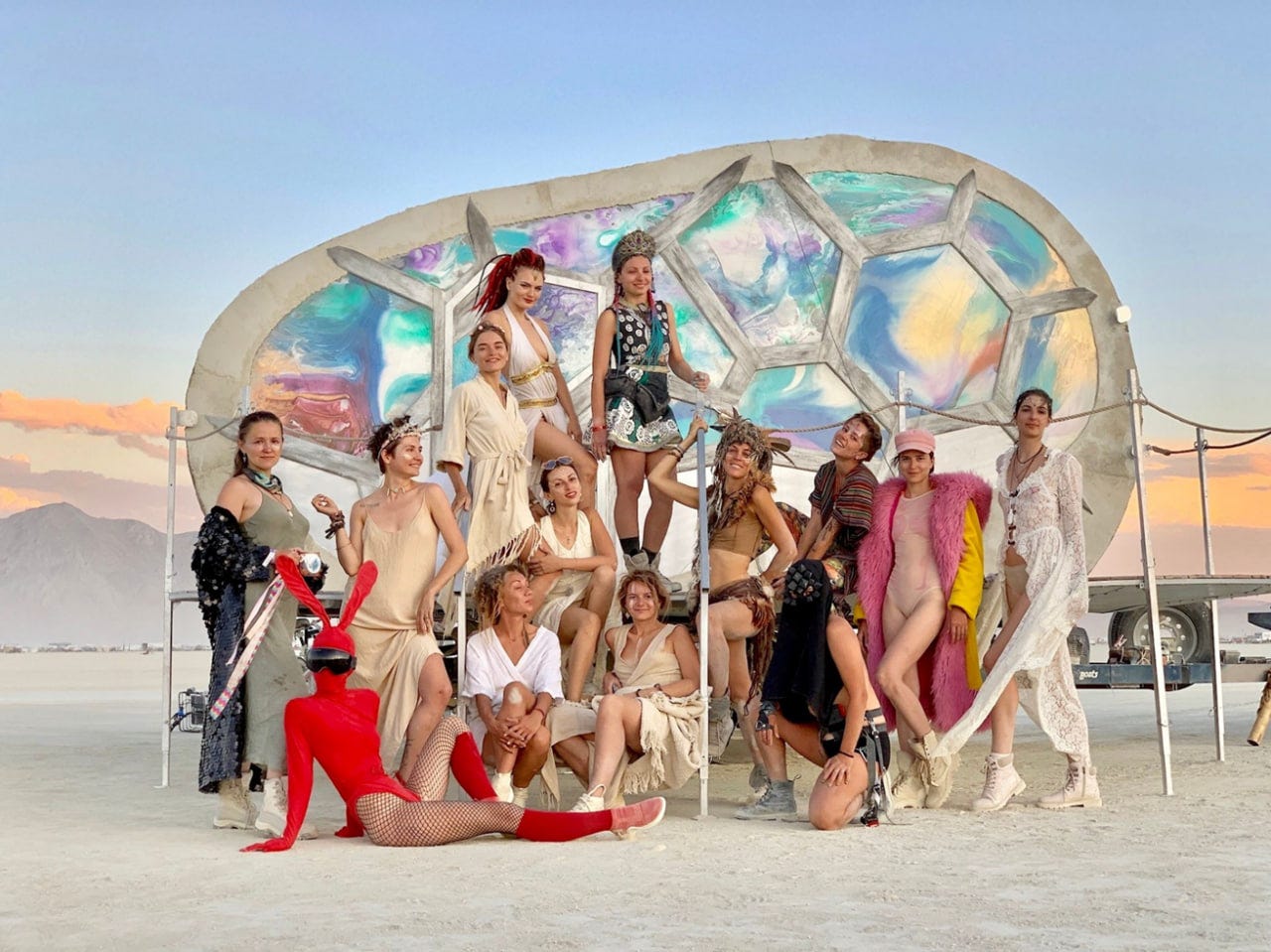
Each year the offering differs depending on which camps are running, says steam aficionado Wendy Liu. You can find Finnish sauna at camps like Black Rock Sauna Society where sauna-elves guide guests through rituals. Art of Steam offers a Russian banya heated by a flamethrower along with venik (whisking) rituals, herbal teas and a huge, dreamy swing for recovery. Blockhaus’ steam bath art car is more of a participatory installation the size of a double-decker bus where burners ascend through steam and emerge, renewed on the top deck where an openair DJ lounge and (naked) dance party await. It’s about spiritual cleanliness and participating in an almost transcendental communal, soul-cleansing experience.
News, happenings and openings
Afar Magazine highlights the Great Victorian Bathing Trail which opened in Victoria, Australia in 2024 to connect natural springs, spas, and sea pools
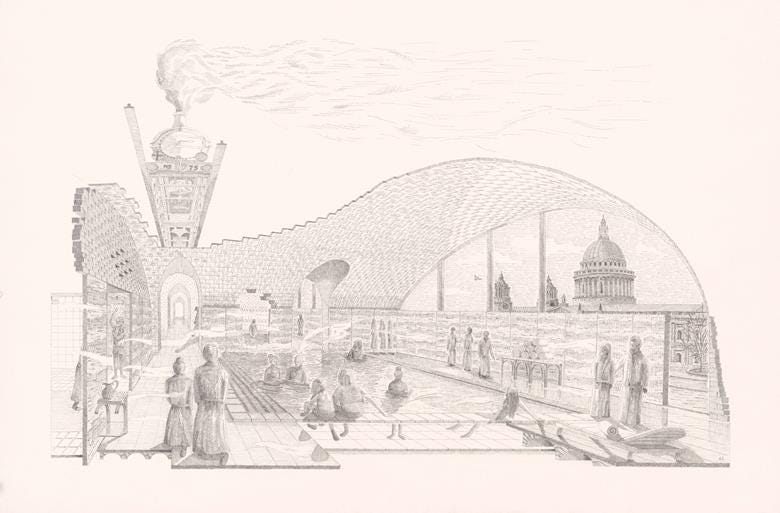
Building reports that architect Tuckey Design Studio and CoB’s own Jane Withers Studio propose reviving the lost tradition of London’s civic bathhouses
The Guardian reports on Sauna Theatre and their 80-seat venue at Edinburgh fringe that combines sauna rituals with theatre, music, storytelling
In another step towards opening, Therme’s planned $850M Dallas resort wins key zoning vote, reports The Dallas Morning News
So excited to get our hands on a copy, we’re sharing again: after 45 years, Mikkel Aaland’s cult classic Sweat is being reissued along side his new book Naked Sweat as a Collector’s Edition. Pre order now
One last thing
Built between 1895 and 1897, Wrocław’s historic swimming hall was designed by architect Wilhelm Werdelmann, with a glass skylight inspired by the grand barrel vaults of Roman baths.
More than 125 years later, the listed building remains intact and open to the public.
We’d love to hear from you - please send a DM, or email hello@cultureofbathe-ing.com